
- Jupyter Notebook Add Cell Shortcut
- Jupiter Notebook Shortcut For Markdown Windows
- Jupyter Notebook Keyboard Shortcuts Pdf
- Jupiter Notebook Shortcut For Markdown Mac
Jupyter (formerly IPython Notebook) is an open-source project that lets you easily combine Markdown text and executable Python source code on one canvas called a notebook. Visual Studio Code supports working with Jupyter Notebooks natively, as well as through Python code files. This topic covers the native support available for Jupyter Notebooks and demonstrates how to:
- Create, open, and save Jupyter Notebooks
- Work with Jupyter code cells
- View, inspect, and filter variables using the Variable explorer and Data viewer
- Connect to a remote Jupyter server
- Debug a Jupyter notebook
Md $ S $: ชุดของร้านค้า $ I $: ชุดของรายการที่ M อยากได้ฉันต้องการสร้างบรรทัดใหม่ระหว่างสองประโยคนี้ เรามักจะใส่ '(เว้นวรรค)' ไว้หลังประโยคแรกก่อนขึ้นบรรทัดใหม่ แต่ไม่ใส่. A Computer Science portal for geeks. It contains well written, well thought and well explained computer science and programming articles, quizzes and practice/competitive programming/company.
Setting up your environment
To work with Jupyter notebooks, you must activate an Anaconda environment in VS Code, or another Python environment in which you've installed the Jupyter package. To select an environment, use the Python: Select Interpreter command from the Command Palette (⇧⌘P (Windows, Linux Ctrl+Shift+P)).
Once the appropriate environment is activated, you can create and open a Jupyter Notebook, connect to a remote Jupyter server for running code cells, and export a Jupyter Notebook as a Python file.
Note: By default, the Visual Studio Code Python extension will open a Jupyter Notebook (.ipynb) in the Notebook Editor. If you want to disable this behavior you can turn it off in settings. (Python > Data Science: Use Notebook Editor).
Create or open a Jupyter Notebook
You can create a Jupyter Notebook by running the Jupyter: Create Blank New Jupyter Notebook command from the Command Palette (⇧⌘P (Windows, Linux Ctrl+Shift+P)) or by creating a new .ipynb file in your workspace. When you select the file, the Notebook Editor is launched allowing you to edit and run code cells.
If you have an existing Jupyter Notebook, you can open it in the Notebook Editor by double-clicking on the file and opening with Visual Studio Code, through the Visual Studio Code, or using the Command Palette Jupyter: Open in Notebook Editor command.
Once you have a Notebook created, you can run a code cell using the green run icon above the cell and the output will appear directly below the code cell.
Trusted Notebooks
It's possible for malicious source code to be contained in a Jupyter Notebook. With that in mind, to help protect you, any Notebook that's not created with VS Code on your local machine (or explicitly set to Trusted by you) is considered Not Trusted. When a Notebook is Not Trusted, VS Code will not render Markdown cells or display the output of code cells within the Notebook. Instead, just the source of Markdown and code cells will be shown. The Notebook is essentially in read-only mode, with toolbars disabled and no ability to edit the file, until you set it as Trusted.
Note: Before setting a Notebook as Trusted, it is up to you to verify that the source code and Markdown are safe to run. VS Code does not perform any sanitizing of Markdown, it merely prevents it from being rendered until a Notebook is marked as Trusted to help protect you from malicious code.
When you first open a Notebook that's Not Trusted, the following notification prompt is displayed.
If you select Trust, the Notebook will be trusted going forward. If you opt not to trust the Notebook, then Not Trusted will be displayed in the toolbar and the Notebook will remain in a read-only state as described previously. If you select Trust all notebooks, you will be taken to settings, where you can specify that all Notebooks opened in VS Code be trusted. That means you will no longer be prompted to trust individual notebooks and harmful code could automatically run.
You can relaunch the trust notification prompt after reviewing the Notebook by clicking on the Not Trusted status.
Save your Jupyter Notebook
You can save your Jupyter Notebook using the keyboard combo Ctrl+S or through the save icon on the Notebook Editor toolbar.
Note: At present, you must use the methods discussed above to save your Notebook. The File>Save menu does not save your Notebook, just the toolbar icon or keyboard command.
Export your Jupyter Notebook
You can export a Jupyter Notebook as a Python file (.py), a PDF, or an HTML file. To export, just click the convert icon on the main toolbar. You'll then be presented with file options from the Command Palette.
Note: For PDF export, you must have TeX installed. If you don't, you will be notified that you need to install it when you select the PDF option. Also, be aware that if you have SVG-only output in your Notebook, they will not be displayed in the PDF. To have SVG graphics in a PDF, either ensure that your output includes a non-SVG image format or else you can first export to HTML and then save as PDF using your browser.
Work with code cells in the Notebook Editor
The Notebook Editor makes it easy to create, edit, and run code cells within your Jupyter Notebook.
Create a code cell
By default, a blank Notebook will have an empty code cell for you to start with and an existing Notebook will place one at the bottom. Add your code to the empty code cell to get started.
Code cell modes
While working with code cells a cell can be in three states, unselected, command mode, and edit mode. The current state of a cell is indicated by a vertical bar to the left of a code cell. When no bar is visible, the cell is unselected.
An unselected cell isn't editable, but you can hover over it to reveal additional cell specific toolbar options. These additional toolbar options appear directly below and to the left of the cell. You'll also see when hovering over a cell that an empty vertical bar is present to the left.
When a cell is selected, it can be in two different modes. It can be in command mode or in edit mode. When the cell is in command mode, it can be operated on and accept keyboard commands. When the cell is in edit mode, the cell's contents (code or Markdown) can be modified.
When a cell is in command mode, the vertical bar to the left of the cell will be solid to indicate it's selected.
When you're in edit mode, the vertical bar will have diagonal lines.
To move from edit mode to command mode, press the ESC key. To move from command mode to edit mode, press the Enter key. You can also use the mouse to change the mode by clicking the vertical bar to the left of the cell or out of the code/Markdown region in the code cell.
Add additional code cells
Code cells can be added to a Notebook using the main toolbar, a code cell's vertical toolbar, the add code cell icon at the bottom of the Notebook, the add code cell icon at the top of the Notebook (visible with hover), and through keyboard commands.
Using the plus icon in the main toolbar will add a new cell directly below the currently selected cell. Using the add cell icons at the top and bottom of the Jupyter Notebook, will add a code cell at the top and bottom respectively. And using the add icon in the code cell's toolbar, will add a new code cell directly below it.
When a code cell is in command mode, the A key can be used to add a cell above and the B can be used to add a cell below the selected cell.
Select a code cell
The selected code cell can be changed using the mouse, the up/down arrow keys on the keyboard, and the J (down) and K (up) keys. To use the keyboard, the cell must be in command mode.
Run a single code cell
Once your code is added, you can run a cell using the green run arrow and the output will be displayed below the code cell.
You can also use key combos to run a selected code cell.
- Ctrl+Enter runs the currently selected cell
- Shift+Enter runs the currently selected cell and, if a cell is not already present, inserts a new cell immediately below (focus moves to the below cell in command mode)
- Alt+Enter runs the currently selected cell and inserts a new cell immediately below (focus moves to new cell in edit mode).
These keyboard combos can be used in both command and edit modes.
Run multiple code cells
Running multiple code cells can be accomplished in a number of ways. You can use the double arrow in the toolbar of the Notebook Editor to run all cells within the Notebook or the run icons with directional arrows to run all cells above or below the current code cell.
Run code by line
To help diagnose issues with your Notebook code, run-by-line lets you step through the code of a cell in a line-by-line fashion. While stepping through code you can view the state of variables at each step via the variable explorer or hover your mouse over variables to see data tips.
To start a session, just click the run-by-line icon to the right of the run cell icon on the cell's toolbar.
Once in a run-by-line session, you can run the currently highlighted line of code by pressing the icon again. To exit, just click the stop button next to the run-by-line icon in the cell.
Move a code cell
Moving code cells up or down within a Notebook can be accomplished using the vertical arrows beside each code cell. Hover over the code cell and then click the up arrow to move the cell up and the down arrow to move the cell down.
Delete a code cell
Deleting a code cell can be accomplished by hovering over a code cell and using the delete icon in the code cell toolbar or through the keyboard combo dd when the selected code cell is in command mode.
Undo your last change
You can use the z key to undo your previous change, for example, if you've made an accidental edit you can undo it to the previous correct state, or if you've deleted a cell accidentally you can recover it.
Switch between code and Markdown
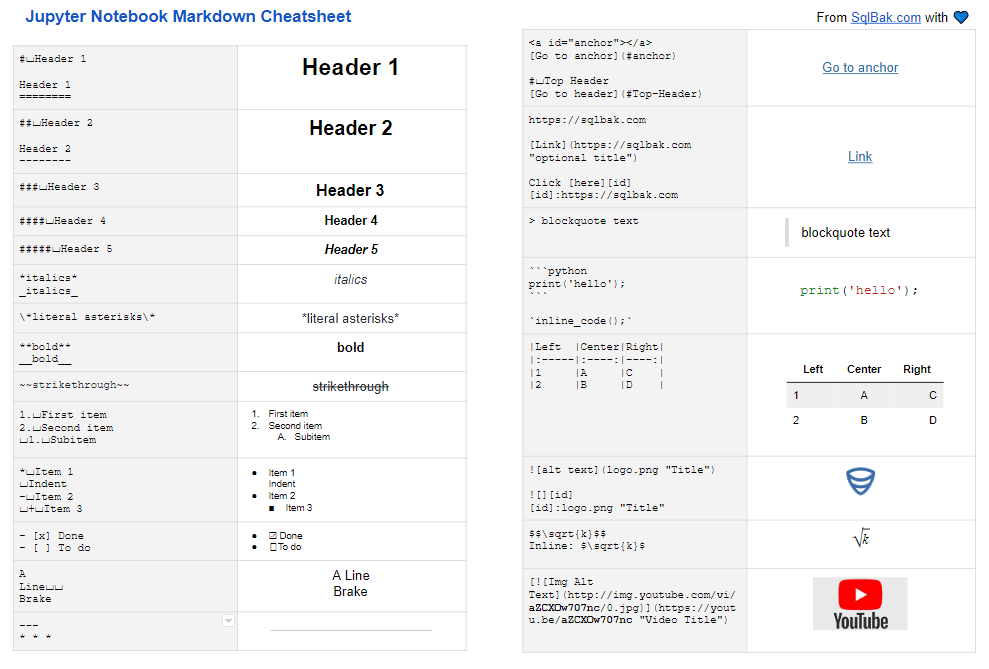
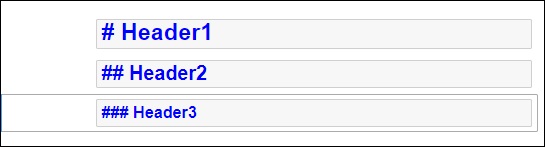
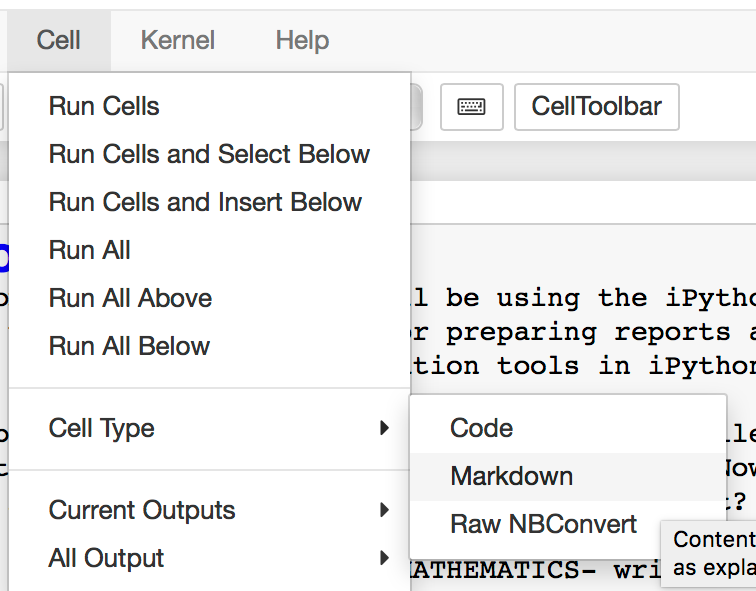
The Notebook Editor allows you to easily change code cells between Markdown and code. By default a code cell is set for code, but just click the Markdown icon (or the code icon, if Markdown was previously set) in the code cell's toolbar to change it.
Once Markdown is set, you can enter Markdown formatted content to the code cell. Once you select another cell or toggle out of the content selection, the Markdown content is rendered in the Notebook Editor.
You can also use the keyboard to change the cell type. When a cell is selected and in command mode, the M key switches the cell type to Markdown and the Y key switches the cell type to code.
Clear output or restart/interrupt the kernel
If you'd like to clear the code cell output or restart/interrupt the kernel, you can accomplish that using the main Notebook Editor toolbar.
Enable/Disable line numbers
You can enable or disable line numbering within a code cell using the L key.
IntelliSense support in the Jupyter Notebook Editor
The Python Jupyter Notebook Editor window has full IntelliSense – code completions, member lists, quick info for methods, and parameter hints. You can be just as productive typing in the Notebook Editor window as you are in the code editor.
Variable explorer and data viewer
Within the Python Notebook Editor, it's possible to view, inspect, and filter the variables within your current Jupyter session. By clicking the Variables icon in the top toolbar after running code and cells, you'll see a list of the current variables, which will automatically update as variables are used in code.
For additional information about your variables, you can also double-click on a row or use the Show variable in data viewer button next to the variable to see a more detailed view of a variable in the Data Viewer. Once open, you can filter the values by searching over the rows.
Note: Variable explorer is enabled by default, but can be turned off in settings (Python > Data Science: Show Jupyter Variable Explorer).
Plot viewer
The Plot Viewer gives you the ability to work more deeply with your plots. In the viewer you can pan, zoom, and navigate plots in the current session. You can also export plots to PDF, SVG, and PNG formats.
Within the Notebook Editor window, double-click any plot to open it in the viewer, or select the plot viewer button on the upper left corner of the plot (visible on hover).
Note: There is support for rendering plots created with matplotlib and Altair.
Debug a Jupyter Notebook
If you need additional debug support in order to diagnose an issue in your code cells, you can export it as a Python file. Once exported as a Python file, the Visual Studio Code debugger lets you step through your code, set breakpoints, examine state, and analyze problems. Using the debugger is a helpful way to find and correct issues in notebook code. To debug your Python file:
In VS Code, if you haven't already, activate a Python environment in which Jupyter is installed.
From your Jupyter Notebook (.ipynb) select the convert button in the main toolbar.
Once exported, you'll have a .py file with your code that you can use for debugging.
After saving the .py file, to start the debugger, use one of the following options:
- For the whole Notebook, open the Command Palette (⇧⌘P (Windows, Linux Ctrl+Shift+P)) and run the Jupyter: Debug Current File in Python Interactive Window command.
- For an individual cell, use the Debug Cell adornment that appears above the cell. The debugger specifically starts on the code in that cell. By default, Debug Cell just steps into user code. If you want to step into non-user code, you need to uncheck Data Science: Debug Just My Code in the Python extension settings (⌘, (Windows, Linux Ctrl+,)).
To familiarize yourself with the general debugging features of VS Code, such as inspecting variables, setting breakpoints, and other activities, review VS Code debugging.
As you find issues, stop the debugger, correct your code, save the file, and start the debugger again.
When you're satisfied that all your code is correct, use the Python Interactive window to export the Python file as a Jupyter Notebook (.ipynb).
Connect to a remote Jupyter server
You can offload intensive computation in a Jupyter Notebook to other computers by connecting to a remote Jupyter server. Once connected, code cells run on the remote server rather than the local computer.
To connect to a remote Jupyter server:
Run the Jupyter: Specify local or remote Jupyter server for connections command from the Command Palette (⇧⌘P (Windows, Linux Ctrl+Shift+P)).
When prompted to Pick how to connect to Jupyter, select Existing: Specify the URI of an existing server.
When prompted to Enter the URI of a Jupyter server, provide the server's URI (hostname) with the authentication token included with a
?token=URL parameter. (If you start the server in the VS Code terminal with an authentication token enabled, the URL with the token typically appears in the terminal output from where you can copy it.) Alternatively, you can specify a username and password after providing the URI.
Note: For added security, Microsoft recommends configuring your Jupyter server with security precautions such as SSL and token support. This helps ensure that requests sent to the Jupyter server are authenticated and connections to the remoter server are encrypted. For guidance about securing a notebook server, see the Jupyter docs.
When working on data science problems, you might want to set up an interactive environment to work and share your code for a project with others. You can easily set this up with a notebook.
In other cases, you’ll just want to communicate about the workflow and the results that you have gathered for the analysis of your data science problem. For a transparent and reproducible report, a notebook can also come in handy.
That's right; notebooks are perfect for situations where you want to combine plain text with rich text elements such as graphics, calculations, etc.
R And The Jupyter Notebook
Contrary to what you might think, Jupyter doesn’t limit you to working solely with Python: the notebook application is language agnostic, which means that you can also work with other languages.
There are two general ways to get started on using R with Jupyter: by using a kernel or by setting up an R environment that has all the essential tools to get started on doing data science.
Running R in Jupyter With The R Kernel
As described above, the first way to run R is by using a kernel. If you want to have a complete list of all the available kernels in Jupyter, go here.
To work with R, you’ll need to load the IRKernel and activate it to get started on working with R in the notebook environment.
First, you'll need to install some packages. Make sure that you don't do this in your RStudio console, but in a regular R terminal, otherwise you'll get an error like this:
This command will prompt you to type in a number to select a CRAN mirror to install the necessary packages. Enter a number and the installation will continue.
Then, you still need to make the R kernel visible for Jupyter:
Now open up the notebook application with jupyter notebook. You'll see R appearing in the list of kernels when you create a new notebook.
Using An R Essentials Environment In Jupyter
The second option to quickly work with R is to install the R essentials in your current environment:
These 'essentials' include the packages dplyr, shiny, ggplot2, tidyr, caret, and nnet. If you don't want to install the essentials in your current environment, you can use the following command to create a new environment just for the R essentials:
Now open up the notebook application to start working with R.
You might wonder what you need to do if you want to install additional packages to elaborate your data science project. After all, these packages might be enough to get you started, but you might need other tools.
Well, you can either build a Conda R package by running, for example:
Or you can install the package from inside of R via install.packages() or devtools::install_github (to install packages from GitHub). You just have to make sure to add the new package to the correct R library used by Jupyter:
If you want to know more about kernels or about running R in a Docker environment, check out this page.
Adding Some R Magic To Jupyter
A huge advantage of working with notebooks is that they provide you with an interactive environment. That interactivity comes mainly from the so-called 'magic commands'.
These commands allow you to switch from Python to command line instructions or to write code in another language such as R, Julia, Scala, …
To switch from Python to R, you first need to download the following package:
After that, you can get started with R, or you can easily switch from Python to R in your data analysis with the %R magic command.
Let's demonstrate how the R magic works with a small example:
If you want more details about Jupyter, on how to set up a notebook, where to download the application, how you can run the notebook application (via Docker, pip install or with the Anaconda distribution) or other details, check out our Definitive Guide.
The R Notebook
Up until recently, Jupyter seems to have been a popular solution for R users, next to notebooks such as Apache Zeppelin or Beaker.
Also, other alternatives to report results of data analyses, such as R Markdown, Knitr or Sweave, have been hugely popular in the R community.
However, this might change with the recent release of the R or R Markdown Notebook by RStudio.
You see it: the context of the R Markdown Notebook is complex, and it's worth looking into the history of reproducible research in R to understand what drove the creation and development of this notebook. Ultimately, you will also realize that this notebook is different from others.
R And The History of Reproducible Research
In his talk, J.J Allaire, confirms that the efforts in R itself for reproducible research, the efforts of Emacs to combine text code and input, the Pandoc, Markdown and knitr projects, and computational notebooks have been evolving in parallel and influencing each other for a lot of years. He confirms that all of these factors have eventually led to the creation and development of notebooks for R.
Firstly, computational notebooks have quite a history: since the late 80s, when Mathematica’s front end was released, there have been a lot of advancements. In 2001, Fernando Pérez started developing IPython, but only in 2011 the team released the 0.12 version of IPython was realized. The SageMath project began in 2004. After that, there have been many notebooks. The most notable ones for the data science community are the Beaker (2013), Jupyter (2014) and Apache Zeppelin (2015).
Then, there are also the markup languages and text editors that have influenced the creation of RStudio's notebook application, namely, Emacs, Markdown, and Pandoc. Org-mode was released in 2003. It’s an editing and organizing mode for notes, planning and authoring in the free software text editor Emacs. Six years later, Emacs org-R was there to provide support for R users. Markdown, on the other hand, was released in 2004 as a markup language that allows you to format your plain text in such a way that it can be converted to HTML or other formats. Fast forward another couple of years, and Pandoc was released. It's a writing tool and as a basis for publishing workflows.
Jupyter Notebook Add Cell Shortcut
Lastly, the efforts of the R community to make sure that research can be reproducible and transparent have also contributed to the rise of a notebook for R. 2002, Sweave was introduced in 2002 to allow the embedding of R code within LaTeX documents to generate PDF files. These pdf files combined the narrative and analysis, graphics, code, and the results of computations. Ten years later, knitr was developed to solve long-standing problems in Sweave and to combine features that were present in other add-on packages into one single package. It’s a transparent engine for dynamic report generation in R. Knitr allows any input languages and any output markup languages.
Also in 2012, R Markdown was created as a variant of Markdown that can embed R code chunks and that can be used with knitr to create reproducible web-based reports. The big advantage was and still is that it isn’t necessary anymore to use LaTex, which has a learning curve to learn and use. The syntax of R Markdown is very similar to the regular Markdown syntax but does have some tweaks to it, as you can include, for example, LaTex equations.
R Markdown Versus Computational Notebooks
R Markdown is probably one of the most popular options in the R community to report on data analyses. It's no surprise whatsoever that it is still a core component in the R Markdown Notebook.
And there are some things that R Markdown and notebooks share, such as the delivering of a reproducible workflow, the weaving of code, output, and text together in a single document, supporting interactive widgets and outputting to multiple formats. However, they differ in their emphases: R Markdown focuses on reproducible batch execution, plain text representation, version control, production output and offers the same editor and tools that you use for R scripts.
On the other hand, the traditional computational notebooks focus on outputting inline with code, caching the output across sessions, sharing code and outputting in a single file. Notebooks have an emphasis on an interactive execution model. They don’t use a plain text representation, but a structured data representation, such as JSON.
That all explains the purpose of RStudio's notebook application: it combines all the advantages of R Markdown with the good things that computational notebooks have to offer.
That's why R Markdown is a core component of the R Markdown Notebook: RStudio defines its notebook as 'an R Markdown document with chunks that can be executed independently and interactively, with output visible immediately beneath the input'.
How To Work With R Notebooks
If you’ve ever worked with Jupyter or any other computational notebook, you’ll see that the workflow is very similar. One thing that might seem very different is the fact that now you’re not working with code cells anymore by default: you’re rather working with a sort of text editor in which you indicate your code chunks with R Markdown.
How To Install And Use The R Markdown Notebook
The first requirement to use the notebook is that you have the newest version of RStudio available on your PC. Since notebooks are a new feature of RStudio, they are only available in version 1.0 or higher of RStudio. So, it’s important to check if you have a correct version installed.
If you don’t have version 1.0 or higher of RStudio, you can download the latest version here.
Then, to make a new notebook, you go to File tab, select'New File', and you'll see the option to create a new R Markdown Notebook. If RStudio prompts you to update some packages, just accept the offer and eventually a new file will appear.
Tip: double-check whether you’re working with a notebook by looking at the top of your document. The output should be html_notebook.
You’ll see that the default text that appears in the document is in R Markdown. R Markdown should feel pretty familiar to you, but if you’re not yet quite proficient, you can always check out our Reporting With R Markdown course or go through the material that is provided by RStudio.
Note that you can always use the gear icon to adjust the notebook's working space: you have the option to expand, collapse, and remove the output of your code, to change the preview options and to modify the output options.
This last option can come in handy if you want to change the syntax highlighting, apply another theme, adjust the default width and height of the figures appearing in your output, etc.
From there onwards, you can start inserting code chunks and text!
You can add code chunks in two ways: through the keyboard shortcut Ctrl + Alt + I or Cmd + Option + I, or with the insert button that you find in the toolbar.
What's great about working with these R Markdown notebooks is the fact that you can follow up on the execution of your code chunks, thanks to the little green bar that appears on the left when you're executing large code chunks or multiple code chunks at once. Also, note that there's a progress bar on the bottom.
You can see the green progress bar appearing in the gif below:
Talking about code execution: there are multiple ways in which you can execute your R code chunks.
You can run a code chunk or run the next chunk, run all code chunks below and above; but you can also choose to restart R and run all chunks or to restart and to clear the output.
Note that when you execute the notebook's code, you will also see the output appearing on your console! That might be a rather big difference for those who usually work with other computational notebooks such as Jupyter.
If there are any errors while the notebook's code chunks are being executed, the execution will stop, and there will appear a red bar alongside the code piece that produces the error.
You can suppress the halt of the execution by adding errors = TRUE in the chunk options, just like this:
Note that the error will still appear, but that the notebook's code execution won't be halted!
How To Use R Markdown Notebook’s Magic
Just like with Jupyter, you can also work interactively with your R Markdown notebooks. It works a bit differently from Jupyter, as there are no real magic commands; To work with other languages, you need to add separate Bash, Stan, Python, SQL or Rcpp chunks to the notebook.
Jupiter Notebook Shortcut For Markdown Windows
These options might seem quite limited to you, but it's compensated in the ease with which you can easily add these types of code chunks with the toolbar's insert button.
Also working with these code chunks is easy: you can see an example of SQL chunks in this document, published by J.J Allaire. For Bash commands, you just type the command. There's no need extra characters such as ‘!’ to signal that you're working in Bash, like you would do when you would work with Jupyter.
How To Output Your R Markdown Notebooks
Before you render the final version of a notebook, you might want to preview what you have been doing. There's a handy feature that allows you to do this: you'll find it in your toolbar.
Click on the 'preview' button and the provisional version of your document will pop up on the right-hand side, in the 'Viewer' tab.
By adding some lines to the first section on top of the notebook, you can adjust your output options, like this:
To see where you can get those distributions, you can just try to knit, and the console output will give you the sites where you can download the necessary packages.
Note that this is just one of the many options that you have to export a notebook: there's also the possibility to render GitHub documents, word documents, beamer presentation, etc. These are the output options that you already had with regular R Markdown files. You can find more info here.
Tips And Tricks To Work With R Notebook
Besides the general coding practices that you should keep in mind, such as documenting your code and applying a consistent naming scheme, code grouping and name length, you can also use the following tips to make a notebook awesome for others to use and read:
- Just like with computational notebooks, it might be handy to split large code chunks or code chunks that generate more than one output into multiple chunks. This way, you will improve the general user experience and increase the transparency of a notebook.
- Make use of the keyboard shortcuts to speed up your work. You will find most of them in the toolbar, next to the commands that you want to perform.
- Use the spellchecker in the toolbar to make sure your report's vocabulary is correct.
- Take advantage of the option to hide your code if a notebook is code-heavy. You can do this through code chunk options or in the HTML file of the notebook itself!
The R Notebook Versus The Jupyter Notebook
Besides the differences between the Jupyter and R Markdown notebooks that you have already read above, there are some more things.
Let's compare Jupyter with the R Markdown Notebook!
There are four aspects that you will find interesting to consider: notebook sharing, code execution, version control, and project management.
Notebook Sharing
The source code for an R Markdown notebook is an .Rmd file. But when you save a notebook, an .nb.html file is created alongside it. This HTML file is an associated file that includes a copy of the R Markdown source code and the generated output.
That means that you need no special viewer to see the file, while you might need it to view notebooks that were made with the Jupyter application, which are simple JSON documents, or other computational notebooks that have structured format outputs. You can publish your R Markdown notebook on any web server, GitHub or as an email attachment.
There also are APIs to render and parse R Markdown notebooks: this gives other frontend tools the ability to create notebook authoring modes for R Markdown. Or the APIs can be used to create conversion utilities to and from different notebook formats.
To share the notebooks you make in the Jupyter application, you can export the notebooks as slideshows, blogs, dashboards, etc. You can find more information in this tutorial. However, there are also the default options to generate Python scripts, HTML files, Markdown files, PDF files or reStructured Text files.
Code Execution
R Markdown Notebooks have options to run a code chunk or run the next chunk, run all code chunks below and above; In addition to these options, you can also choose to restart R and run all chunks or to restart and to clear the output.
These options are interesting when you’re working with R because the R Markdown Notebook allows all R code pieces to share the same environment. However, this can prove to be a huge disadvantage if you’re working with non-R code pieces, as these don’t share environments.
All in all, these code execution options add a considerable amount of flexibility for the users who have been struggling with the code execution options that Jupyter offers, even though if these are not too much different: in the Jupyter application, you have the option to run a single cell, to run cells and to run all cells. You can also choose to clear the current or all outputs. The code environment is shared between code cells.
Version control
There have been claims that Jupyter messes up the version control of notebooks or that it's hard to use git with these notebooks. Solutions to this issue are to export the notebook as a script or to set up a filter to fix parts of the metadata that shouldn't change when you commit or to strip the run count and output.
The R Markdown notebooks seem to make this issue a bit easier to handle, as they have associated HTML files that save the output of your code and the fact that the notebook files are essentially plain text files, version control will be much easier. You can choose to only put your .Rmd file on GitHub or your other versioning system, or you can also include the .nb.html file.
Project Management
As the R Markdown Notebook is native to the RStudio development kit, the notebooks will seamlessly integrate with your R projects. Also, these notebooks support other languages, including Python, C, and SQL.
On the other hand, the Jupyter project is not native to any development kit: in that sense, it will cost some effort to integrate this notebook seamlessly with your projects. But this notebook still supports more languages and will be a more suitable companion for you if you’re looking for use Scala, Apache Toree, Julia, or another language.
Alternatives to Jupyter or R Markdown Notebooks
Apart from the notebooks that you can use as interactive data science environments which make it easy for you to share your code with colleagues, peers, and friends, there are also other alternatives to consider.
Because sometimes you don't need a notebook, but a dashboard, an interactive learning platform or a book, for example.
You have already read about options such as Sweave and Knitr in the second section. Some other options that are out there, are:
Jupyter Notebook Keyboard Shortcuts Pdf
Jupiter Notebook Shortcut For Markdown Mac
- Even though this blog post has covered R Markdown to some extent, you should know that you can do so much more with it. For example, you can build dashboards with flexdashboard.
- Or you can use Bookdown to quickly publish HTML, PDF, ePub, and Kindle books with R Markdown.
- Shiny is a tool that you can also use to create dashboards. To get started with Shiny, go to this page.
- In an educational setting, DataCamp Light might also come in handy to create interactive tutorials on your blog or website. If you want to see DataCamp light at work, go to this tutorial, for example.