
Cisco Systems VPN Client is a software application for connecting to virtual private networks based on Internet Key Exchange version 1. On July 29, 2011, Cisco announced the end of life of the product. No further product updates were released after July 30, 2012, and support ceased on July 29, 2014. Cisco AnyConnect VPN Instructions (Mac OS) Howard University Part I: Client Setup Browse to This link is going to take you to a download file for the Cisco AnyConnect VPN client. Download this and install it. NOTE: this step only works from outside the Howard University network.
Follow the instructions below to download, install and connect the AnyConnect Secure Mobility Client on your Mac computer (OS X 10.9 or newer) to the new MSU VPN.
Cisco Anyconnect Secure Mobility Client Mac
Instructions
Download:
Cisco Anyconnect Vpn Client Free Download For Mac Os X
- Go to https://www3.montana.edu/software.
Locate the Cisco AnyConnect (VPN Client) section (see image below). - Click box next to I accept Software Terms of Use.
- Click the AnyConnect Secure Mobility Client (4.8) download link in the Mac OS X row (shownin red below).
The installer file downloads. When download is complete, follow steps below to install.
Install client:
- Go to your Downloads folder (or whatever location the file was downloaded to) and double-click anyconnect-macos-4.8.00175-core-vpn-webdeploy-k9.dmg to unzip.
- Double-click anyconnect-macos-...pkg file to begin installation (see 1st image below).
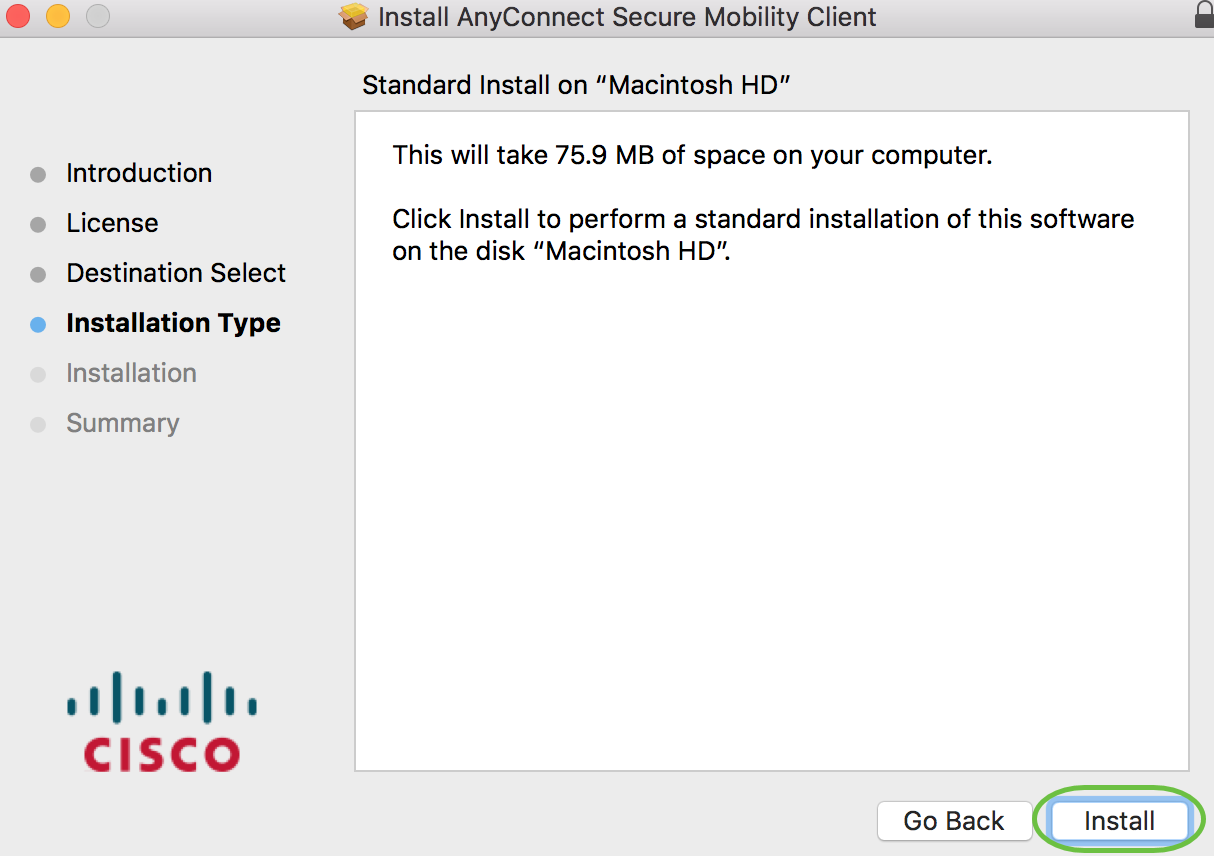
The AnyConnect Secure Mobility Client Installer window opens (see 2nd image below). - Click Continue and follow the steps to install.
- Enter your computer's password when prompted.
- Click Close to shut installer window, after installation is finished.
- Click the Move to Trash button when prompted.
Cisco anyconnect vpn client for mac free download - Cisco VPN Client, Vpn One Click Mac, PureVPN Mac VPN Software, and many more programs. End-of-Life Announcement for the Cisco AnyConnect VPN Client 2.5 (for Desktop) EOL/EOS for the Cisco AnyConnect VPN Client 2.3 and Earlier (All Versions) and 2.4 (for Desktop) EOL/EOS for the Cisco Secure Desktop 3.4.x and Earlier; EOL/EOS for the Cisco SSL VPN Client; View all documentation of this type.


Installation will now be complete.
Connect to VPN:
- Go to your Applications folder, open the Cisco folder and then click the Cisco AnyConnect Secure Mobility Client. app.
The AnyConnect window opens (see image below). - Enter vpn.msu.montana.edu (if not already entered) and click Connect (see top image below).
In the login window that opens (see bottom image): - Select Group (appropriate for you role at MSU, ie MSU-Employee or MSU-Student).
- Enter NetID and NetID password, click OK.
Cisco Anyconnect Vpn Client For Mac Os X 10.9 Download
You will now be connected to the MSU VPN. The Cisco icon in the dock will now have a little padlock on it and a tiny version Cisco round logo with padlock will be displayed on top menu bar.
To disconnect:
Right-click on the icon in top menu bar and select Disconnect.
Download Cisco Vpn Anyconnect Client For Mac Catalina
To connect in the future:
Download Cisco Vpn Anyconnect Client For Mac Windows 10
You will no longer go through Network Preferences to connect to the VPN, just use the AnyConnect app.
Cisco Vpn Client Anyconnect Download For Mac Os

Connect by right-clicking on the Cisco AnyConnect icon in the top menu bar or dock, then click the Connect button in the 'VPN Ready to connect' box.
If you don't see the icon in your top menu bar or dock, go to your Applications folder, open the Cisco folder and click the AnyConnect Secure Mobility Client.app. Next click the Connect button as shown in the image under step 4 above.
Apple recently released Mac OS X 10.11.4, the latest update for OS X El Capitan. I’m generally an early adopter. If I’m not running a beta release (which I must admit, I’m not doing nearly as much of anymore), I am certainly the first in line to update OS X or iOS to the latest release as soon as it’s reached GA status.
If you’re like me, the latest OS X update, 10.11.4, broke some VPN profiles, specifically certain Cisco IPsec profiles. When I first discovered the VPN client wouldn’t connect to a Cisco IPsec profile that was working just fine before the update, I first thought it may be a problem on the remote end, or even perhaps with my ISP. I tried a secondary VPN profile that’s L2TP over IPsec and had no issues. I then tried a third profile using Cisco IPsec, with no luck. After successfully connecting to a fourth VPN profile (also L2TP over IPsec), I was beginning to think the issue had nothing at all to do with the original VPN endpoint I was attempting to connect to or my ISP. A quick test of the same VPN profiles on a second Mac that had been updated to 10.11.4 yielded the same results, even when connected to a second ISP, confirming my theory.
Cisco Vpn Mac Download
What next? Google to the rescue, of course!
A quick search for “OSX 10.11.4 IPsec” yielded a thread in Apple’s Support Communities that was opened just yesterday with multiple users having similar issues. Yes, I was on to something – my Google Foo was strong!
After reading through a handful of “me too’s”, I found a reply that suggested increasing the DH Group to 14 on the VPN appliance would fix the issue. Of course I was remote – the reason I was trying to connect to VPN in the first place, so I couldn’t test this theory until later when I actually made it onsite. I can confirm that in my case, changing the DH Group to 14 solved my problem. It appears that starting with OS X 10.11.4, Apple requires a minimum of a 2048 bit modulus (DH Group 14) to connect to IPSec VPNs. These two “broken” VPN profiles were using 1024 bit modulus.
How to modify an existing IPsec Tunnel on a FortiGate firewall using FortiOS 5.4
If you have an IPSec VPN Tunnel configured on a FortiGate firewall, and you used the default “Dialup – Cisco IPsec Client” template, it’s likely that your DH Group is set to 2. I couldn’t find a way to modify the DH Group for an existing IPSec tunnel in the FortiOS 5.4 GUI, but here are the CLI commands to make the change:FW01 # config vpn ipsec phase1-interfaceFW01 (phase1-interface) # edit YOUR_VPN_TUNNELFW01 (YOUR_VPN_TUNNEL) # set dhgrp 14FW01 (YOUR_VPN_TUNNEL) # end
That’s it! One thing I love about the FortiOS CLI is that it’s incredibly powerful, yet very easy to navigate – much easier to navigate than Cisco IOS in my opinion. I was able to apply this to a handful of FortiGate firewalls that I manage for SquarePlanIT customers who were using Cisco IPsec VPN tunnels and weren’t already using a 2048 bit modulus. Speaking of managed firewalls – if you’re looking for a managed IT solutions provider, or even just have some project work to knock out, get in touch! I’d love to tell you about all that we have to offer.
Cisco Vpn Macos Big Sur
Learn more about Diffie-Hellman groups
To learn more about the Diffie-Hellman key exchange, here’s an excellent Wikipedia article. For a brief overview of the different DH Groups that can be configured, check out here’s a Cisco Support Community article.
Cisco Anyconnect Vpn Client Macos