
- Calculating Average Atomic Mass Of Isotopes
- Calculating Average Atomic Mass Equation
- Atomic Mass Calculation Formula
- Mass Spec Calculator
- Calculating Average Atomic Mass Worksheet Pdf
- Calculating Average Atomic Mass Unit
The first isotope has an atomic mass of 34.96885 and has an abundance of 75.78%. The second isotope has an atomic mass of 36.96590 and has an abundance of 24.22%. Step 1: (Atomic mass of each isotope) x (%Abundance /100) 34.96885.0.7578 = 26.50 (i). The average atomic mass of an element is the sum of the masses of its isotopes, each multiplied by its natural abundance. Average atomic mass can be found on the periodic table. Formula to calculate average atomic mass.
Calculate the average atomic weight when given isotopic weights and abundances
Fifteen Examples
To do these problems you need some information: the exact atomic weight for each naturally-occuring stable isotope and its percent abundance. These values can be looked up in a standard reference book such as the 'Handbook of Chemistry and Physics.' The unit associated with the answer can be either amu or g/mol, depending on the context of the question. If it is not clear from the context that g/mol is the desired answer, go with amu (which means atomic mass unit).
This problem can also be reversed, as in having to calculate the isotopic abundances when given the atomic weight and isotopic weights. Study the tutorial below and then look at the problems done in the reverse direction.
Example #1: Carbon
| mass number | exact weight | percent abundance |
| 12 | 12.000000 | 98.90 |
| 13 | 13.003355 | 1.10 |
To calculate the average atomic weight, each exact atomic weight is multiplied by its percent abundance (expressed as a decimal). Then, add the results together and round off to an appropriate number of significant figures.
This is the solution for carbon:
(12.000000) (0.9890) + (13.003355) (0.0110) = 12.011 amu
Example #2: Nitrogen
| mass number | exact weight | percent abundance |
| 14 | 14.003074 | 99.63 |
| 15 | 15.000108 | 0.37 |
This is the solution for nitrogen:
(14.003074) (0.9963) + (15.000108) (0.0037) = 14.007 amu
| Example #3: Chlorine | Example #4: Silicon | ||||
| mass number | exact weight | percent abundance | mass number | exact weight | percent abundance |
| 35 | 34.968852 | 75.77 | 28 | 27.976927 | 92.23 |
| 37 | 36.965903 | 24.23 | 29 | 28.976495 | 4.67 |
| 30 | 29.973770 | 3.10 | |||
| The answer for chlorine: 35.453 | The answer for silicon: 28.086 | ||||
This type of calculation can be done in reverse, where the isotopic abundances can be calculated knowing the average atomic weight. Go to tutorial on reverse direction.
Example #5: In a sample of 400 lithium atoms, it is found that 30 atoms are lithium-6 (6.015 g/mol) and 370 atoms are lithium-7 (7.016 g/mol). Calculate the average atomic mass of lithium.
Solution:
1) Calculate the percent abundance for each isotope:
Li-6: 30/400 = 0.075
Li-7: 370/400 = 0.925
2) Calculate the average atomic weight:
x = (6.015) (0.075) + (7.016) (0.925)x = 6.94 g/mol
Example #6: A sample of element X contains 100 atoms with a mass of 12.00 and 10 atoms with a mass of 14.00. Calculate the average atomic mass (in amu) of element X.
Solution:
1) Calculate the percent abundance for each isotope:
X-12: 100/110 = 0.909
X-14: 10/110 = 0.091
2) Calculate the average atomic weight:
x = (12.00) (0.909) + (14.00) (0.091)x = 12.18 amu (to four sig figs)
3) Here's another way:
100 atoms with mass 12 = total atom mass of 120010 atoms with mass 14 = total atom mass of 140

1200 + 140 = 1340 (total mass of all atoms)
Total number of atoms = 100 + 10 = 110
1340/110 = 12.18 amu
The first way is the standard technique for solving this type of problem. That's because we do not generally know the specific number of atoms in a given sample. More commonly, we know the percent abundances, which is different from the specific number of atoms in a sample.
Example #7: Boron has an atomic mass of 10.81 amu according to the periodic table. However, no single atom of boron has a mass of 10.81 amu. How can you explain this difference?
Solution:
10.81 amu is an average, specifically a weighted average. It turns out that there are two stable isotopes of boron: boron-10 and boron-11.
Neither isotope weighs 10.81 amu, but you can arrive at 10.81 amu like this:x = (10.013) (0.199) + (11.009) (0.801)x = 1.99 + 8.82 = 10.81
Example #8: Copper occurs naturally as Cu-63 and Cu-65. Which isotope is more abundant?
Solution:
Look up the atomic weight of copper: 63.546 amuSince our average value is closer to 63 than to 65, we concude that Cu-63 is the more abundant isotope.
Example #9: Copper has two naturally occuring isotopes. Cu-63 has an atomic mass of 62.9296 amu and an abundance of 69.15%. What is the atomic mass of the second isotope? What is its nuclear symbol?
Solution:
1) Look up the atomic weight of copper:
63.546 amu
2) Set up the following and solve:
Calculating Average Atomic Mass Of Isotopes
(62.9296) (0.6915) + (x) (0.3085) = 63.54643.5158 + 0.3085x = 63.546
0.3085x = 20.0302
x = 64.9277 amu
3) The nuclear symbol is:
4) You might see this
29-Cu-65This is used in situations, such as the Internet, where the subscript/superscript notation cannot be reproduced. You might also see this:
65/29Cu
Example #10: Naturally occurring iodine has an atomic mass of 126.9045. A 12.3849 g sample of iodine is accidentally contaminated with 1.0007 g of I-129, a synthetic radioisotope of iodine used in the treatment of certain diseases of the thyroid gland. The mass of I-129 is 128.9050 amu.Find the apparent 'atomic mass' of the contaminated iodine.
Solution:
1) Calculate mass of contaminated sample:
12.3849 g + 1.0007g = 13.3856 g
2) Calculate percent abundances of (a) natural iodine and (b) I-129 in the contaminated sample:
(a) 12.3849 g / 13.3856 g = 0.92524
(b) 1.0007 g / 13.3856 g = 0.07476
3) Calculate 'atomic mass' of contaminated sample:
(126.9045) (0.92524) + (128.9050) (0.07476) = xx = 127.0540 amu
Example #11: Neon has two major isotopes, Neon-20 and Neon-22. Out of every 250 neon atoms, 225 will be Neon-20 (19.992 g/mol), and 25 will be Neon-22 (21.991 g/mol). What is the average atomic mass of neon?
Solution:
1) Determine the percent abundances (but leave as a decimal):
Ne-20 ---> 225 / 250 = 0.90Ne-22 ---> 25 / 250 = 0.10
The last value can also be done by subtraction, in this case 1 - 0.9 = 0.1
2) Calculate the average atomic weight:
(19.992) (0.90) + (21.991) (0.10) = 20.19
Example #12: Calculate the average atomic weight for magnesium:
| mass number | exact weight | percent abundance |
| 24 | 23.985042 | 78.99 |
| 25 | 24.985837 | 10.00 |
| 26 | 25.982593 | 11.01 |

The answer? Find magnesium on the periodic table:
Remember that the above is the method by which the average atomic weight for the element is computed. No one single atom of the element has the given atomic weight because the atomic weight of the element is an average, specifically called a 'weighted' average. Given that, here is a question you could be asked.
Example #13: Silver has an atomic mass of 107.868 amu. Does any atom of any isotope of silver have a mass of 107.868 amu? Explain why or why not.
Solution:
The specific question is about silver, but it could be any element. The answer, of course, is no. The atomic weight of silver is a weighted average. Silver is not composed of atoms each of which weighs 107.868.
Example #14: Given that the average atomic mass of hydrogen in nature is 1.0079, what does that tell you about the percent composition of H-1 and H-2 in nature?
Solution:
It tells you that the proportion of H-1 is much much greater than the proportion of H-2 in nature.
Example #15: The relative atomic mass of neon is 20.18 It consists of three isotopes with the masses of 20, 21and 22. It consists of 90.5% of Ne-20. Determine the percent abundances of the other two isotopes.
Solution:
1) Let y% be the relative abundance of Ne-21.
2) Then, the relative abundance of Ne-22 is:
(100 − 90.5 − y)% = (9.5 − y)%
3) Relative atomic mass of Ne (note use of decimal abundances, not percent abundances):
(20) (0.905) + (21) (y) + (22) (0.095 − y) = 20.1818.10 + 21y + 2.09 - 22y = 20.18
y = 0.01
Relative abundance of (note use of percents):
Ne-21 = 1%Ne-22 = (9.5 − 1)% = 8.5%
How do you calculate atomic mass from isotopic composition ?
1 Answer
Calculating Average Atomic Mass Equation
You calculate the atomic mass of an element by taking the average mass of all of its atoms. Antique letter box for sale.
The atomic mass of an element is a weighted average of the masses of all the element's isotopes based on their percentage abundances.
You arbitrarily choose some number of atoms, calculate the numbers of each isotope, add up all their masses, and then get the average mass.
EXAMPLE:
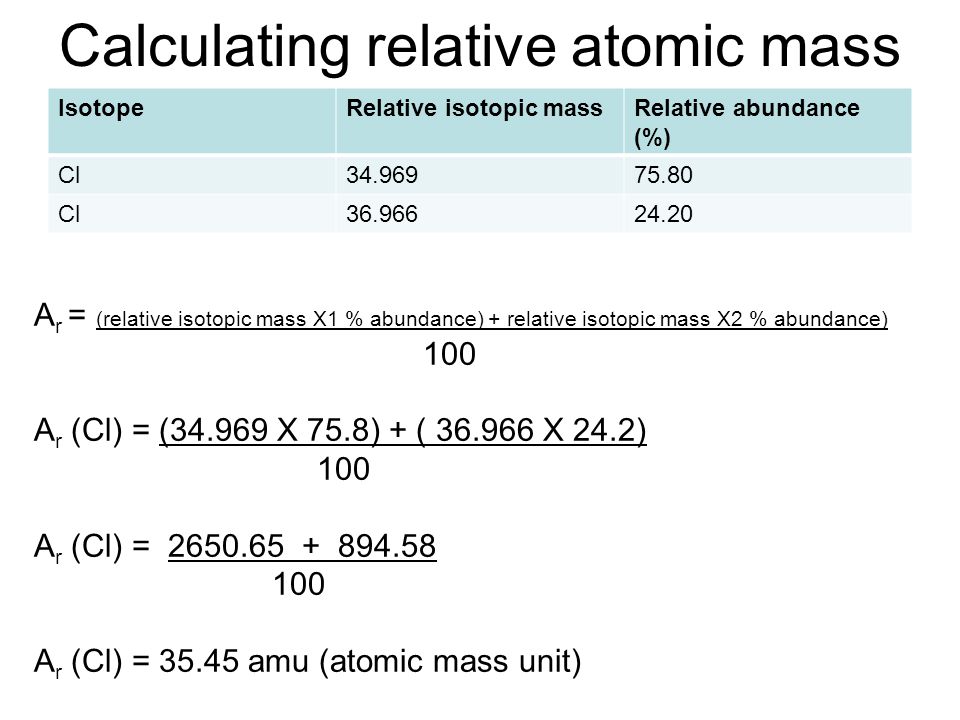
You are given a sample containing 75.77 % chlorine-35 atoms and 24.23 % chlorine-37 atoms. If the atomic mass of Cl-35 is 34.969 u and the atomic mass of Cl-37 is 36.965 u, what is the atomic mass of chlorine?
Solution:
Assume that we have 10 000 Cl atoms (we could assume any number). Then we have 7577 Cl-35 atoms and 2423 Cl-37 atoms.
Mass of 7577 Cl-35 atoms = 7577 atoms × (34.969 u)/(1 atom) =
264 960 u
Mass of 2423 Cl-37 atoms = 2423 atoms × (36.965 u)/(1 atom) =
89 566 u
Atomic Mass Calculation Formula
Mass of 10 000 atoms of Cl = 354 526 u
Mass Spec Calculator
Average mass of a Cl atom = (354 526 u)/(10 000 atoms) = 35.45 u
Calculating Average Atomic Mass Worksheet Pdf
We are allowed to use only 4 significant figures in the answer because we were given only 4 significant figures for the isotope percentages.
Calculating Average Atomic Mass Unit
Related questions